publications
publications by categories in reversed chronological order.
2026
-
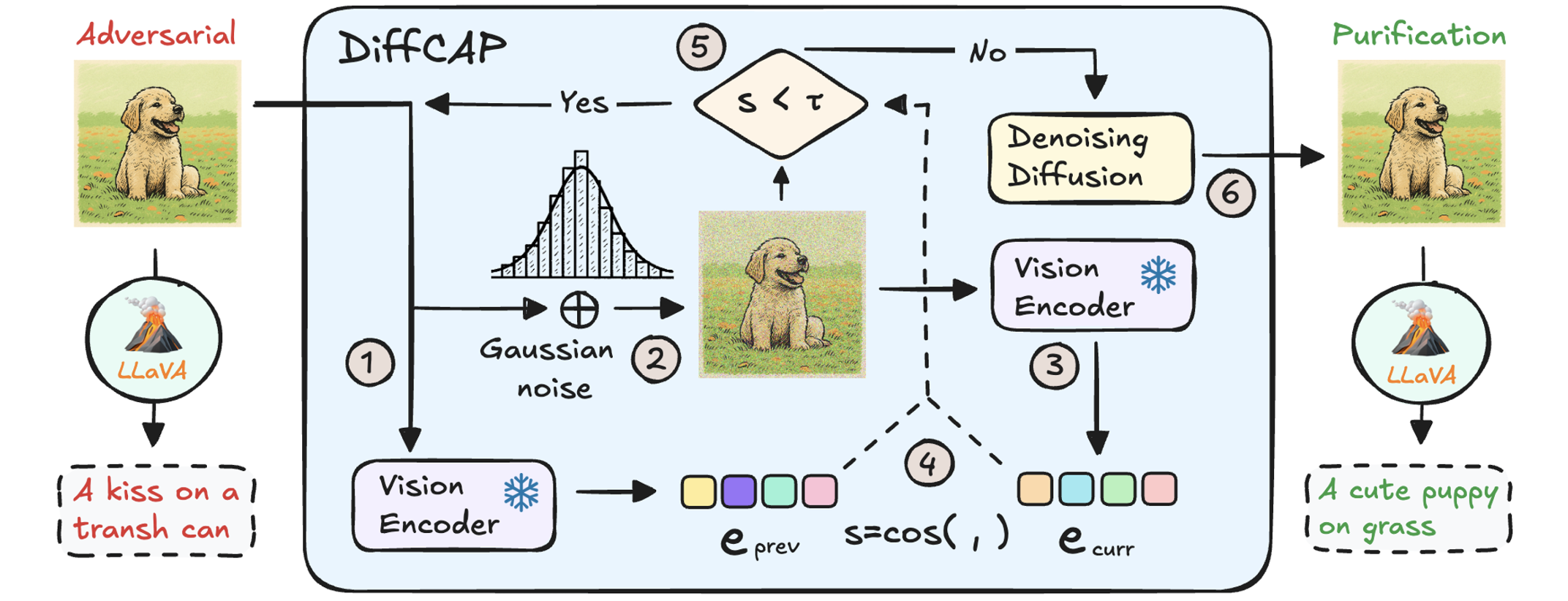 Diffusion-based cumulative adversarial purification for
vision language modelsFu, J., Wu, Y., Chen, Y., Peng, K., Zhang, X., Cevher, V., Pashami, S., and Holst, A.Transactions on Machine Learning Research, Jun 2026Vision Language Models (VLMs) have shown remarkable capabilities in multimodal understanding, yet their susceptibility to adversarial perturbations poses a significant threat to their reliability in real-world applications. Despite often being imperceptible to humans, these perturbations can drastically alter model outputs, leading to erroneous interpretations and decisions. This paper introduces DiffCAP, a novel diffusion-based purification strategy that can effectively neutralize adversarial corruptions in VLMs. We theoretically establish a provable recovery region in the forward diffusion process and meanwhile quantify the convergence rate of semantic variation with respect to VLMs. These findings manifest that adversarial effects monotonically fade as diffusion unfolds. Guided by this principle, DiffCAP leverages noise injection with a similarity threshold of VLM embeddings as an adaptive criterion, before reverse diffusion restores a clean and reliable representation for VLM inference. Through extensive experiments across six datasets with three VLMs under varying attack strengths in three task scenarios, we show that DiffCAP outperforms existing defense techniques by a substantial margin. Notably, DiffCAP significantly reduces both hyperparameter tuning complexity and the required diffusion time, thereby accelerating the denoising process. Equipped with theorems and empirical support, DiffCAP provides a robust and practical solution for securely deploying VLMs in adversarial environments. The source code is available at https://github.com/JasonFu1998/DiffCAP.
-
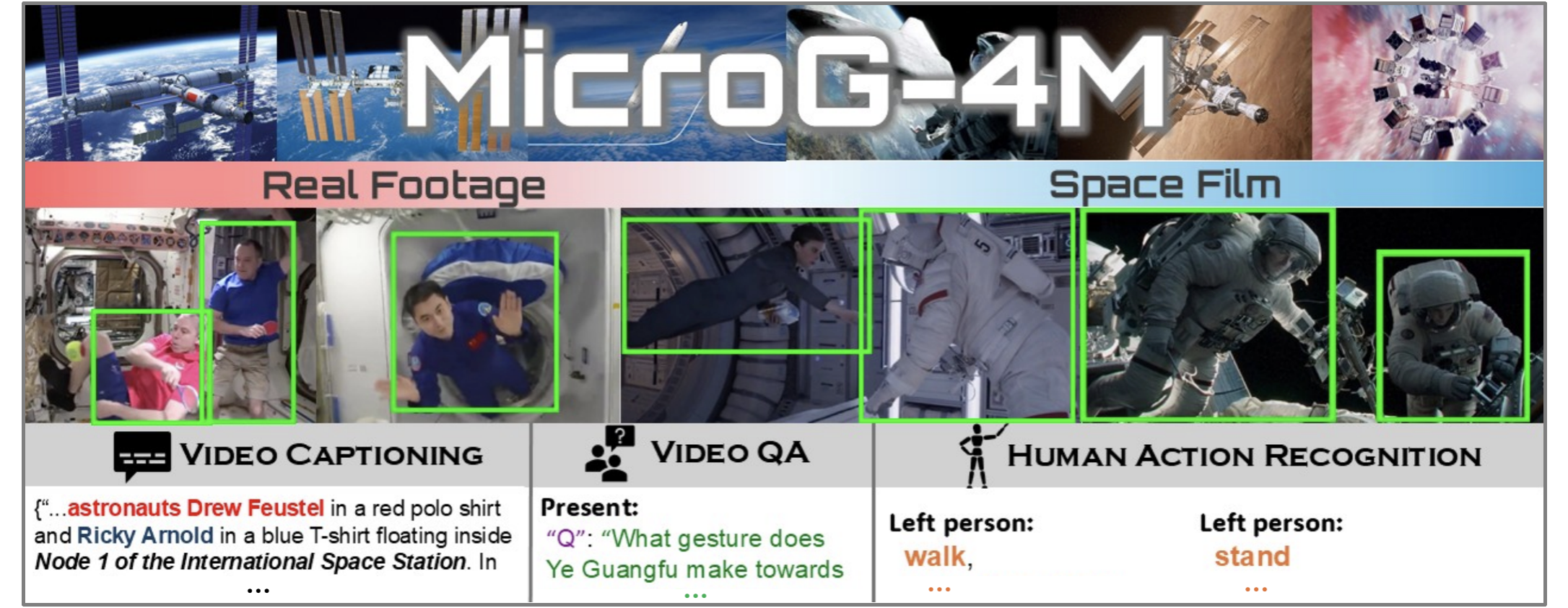 Go beyond earth: understanding human actions and scenes in microgravity environmentsWen, D., Qi, L., Peng, K., Yang, K., Teng, F., Luo, A., Fu, J., Chen, Y., Liu, R., Shi, Y., Sarfraz, M., and Stiefelhagen, R.In International Conference on Learning Representations, Rio de Janeiro, Brazil, Apr 2026
Despite substantial progress in video understanding, most existing datasets are limited to Earth’s gravitational conditions. However, microgravity alters human motion, interactions, and visual semantics, revealing a critical gap for real-world vision systems. This presents a challenge for domain-robust video understanding in safety-critical space applications. To address this, we introduce MicroG-4M, the first benchmark for spatio-temporal and semantic understanding of human activities in microgravity. Constructed from real-world space missions and cinematic simulations, the dataset includes 4,759 clips with 13,261 action annotations covering 50 actions, 1,238 context-rich captions, and over 7,000 question-answer pairs on astronaut activities and scene understanding. MicroG-4M aims to support three core tasks: fine-grained multi-label action recognition, temporal video captioning, and visual question answering, thereby enabling a comprehensive evaluation of both spatial localization and semantic reasoning in microgravity contexts. We establish baselines using state-of-the-art models. All data, annotations, and code are available at https://github.com/lei-qi-233/MicroG-4M.
2025
-
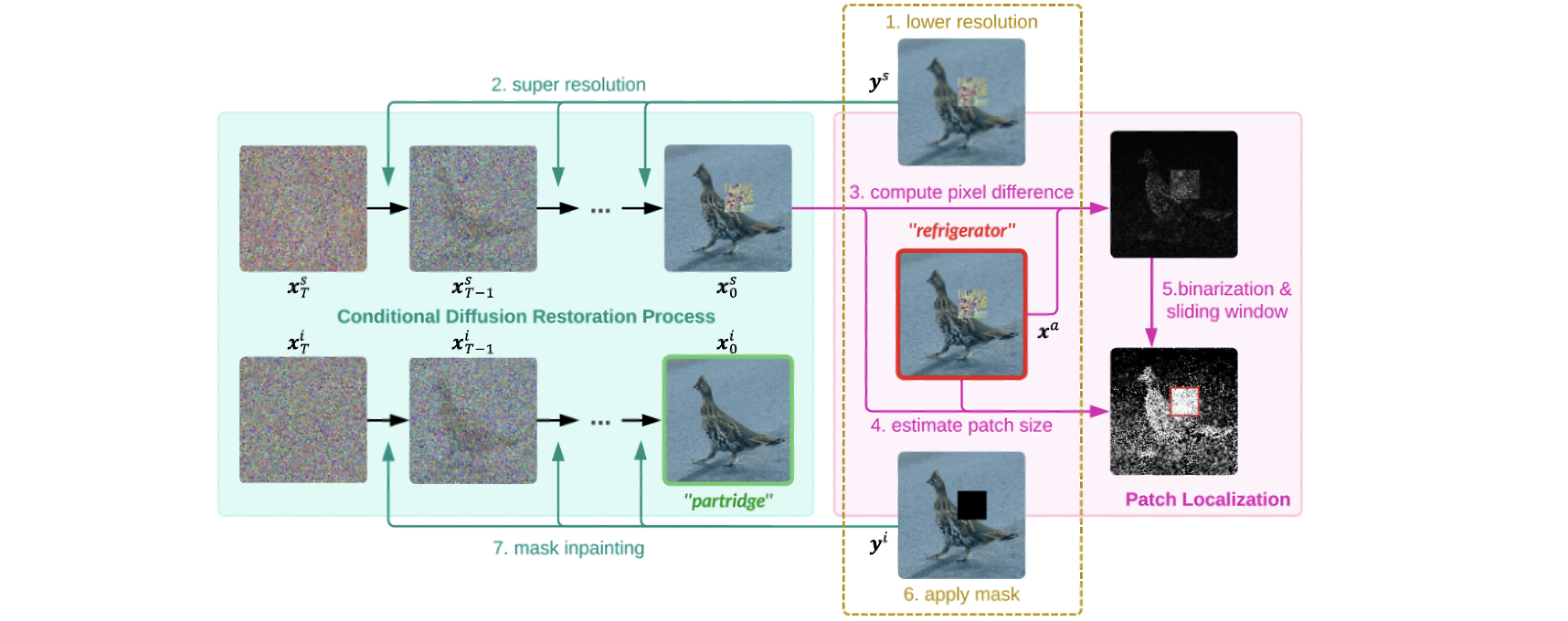 DiffPAD: Denoising diffusion-based adversarial patch decontaminationFu, J., Zhang, X., Pashami, S., Rahimian, F., and Holst, A.In IEEE/CVF Winter Conference on Applications of Computer Vision, Tuscon, Arizona, USA, Feb 2025
In the ever-evolving adversarial machine learning landscape, developing effective defenses against patch attacks has become a critical challenge, necessitating reliable solutions to safeguard real-world AI systems. Although diffusion models have shown remarkable capacity in image synthesis and have been recently utilized to counter l_p-norm bounded attacks, their potential in mitigating localized patch attacks remains largely underexplored. In this work, we propose DiffPAD, a novel framework that harnesses the power of diffusion models for adversarial patch decontamination. DiffPAD first performs super-resolution restoration on downsampled input images, then adopts binarization, dynamic thresholding scheme and sliding window for effective localization of adversarial patches. Such a design is inspired by the theoretically derived correlation between patch size and diffusion restoration error that is generalized across diverse patch attack scenarios. Finally, DiffPAD applies inpainting techniques to the original input images with the estimated patch region being masked. By integrating closed-form solutions for super-resolution restoration and image inpainting into the conditional reverse sampling process of a pre-trained diffusion model, DiffPAD obviates the need for text guidance or fine-tuning. Through comprehensive experiments, we demonstrate that DiffPAD not only achieves state-of-the-art adversarial robustness against patch attacks but also excels in recovering naturalistic images without patch remnants. The source code is available at https://github.com/JasonFu1998/DiffPAD.
2024
-
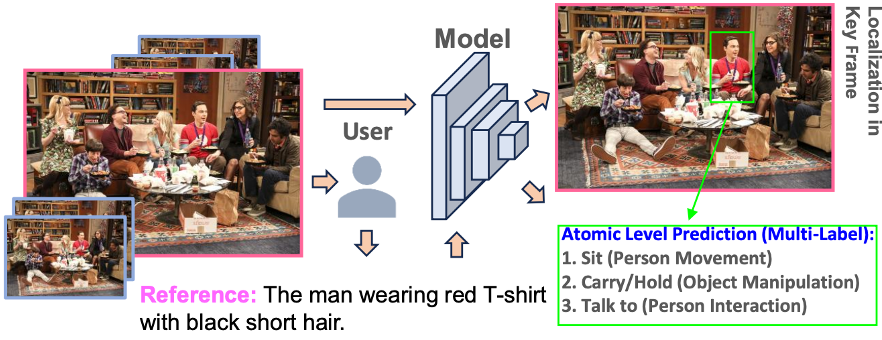 Referring atomic video action recognitionPeng, K.*, Fu, J.*, Yang, K., Wen, D., Chen, Y., Liu, R., Zheng, J., Zhang, J., Sarfraz, M., Stiefelhagen, R., and Roitberg, A.In European Conference on Computer Vision, Milan, Italy, Oct 2024 (* indicates shared first author)
We introduce a new task called Referring Atomic Video Action Recognition (RAVAR), aimed at identifying atomic actions of a particular person based on a textual description and the video data of this person. This task differs from traditional action recognition and localization, where predictions are delivered for all present individuals. In contrast, we focus on recognizing the correct atomic action of a specific individual, guided by text. To explore this task, we present the RefAVA dataset, containing 36,630 instances with manually annotated textual descriptions of the individuals. To establish a strong initial benchmark, we implement and validate baselines from various domains, e.g., atomic action localization, video question answering, and text-video retrieval. Since these existing methods underperform on RAVAR, we introduce RefAtomNet – a novel cross-stream attention-driven method specialized for the unique challenges of RAVAR: the need to interpret a textual referring expression for the targeted individual, utilize this reference to guide the spatial localization and harvest the prediction of the atomic actions for the referring person. The key ingredients are: (1) a multi-stream architecture that connects video, text, and a new location-semantic stream, and (2) cross-stream agent attention fusion and agent token fusion which amplify the most relevant information across these streams and consistently surpasses standard attention-based fusion on RAVAR. Extensive experiments demonstrate the effectiveness of RefAtomNet and its building blocks for recognizing the action of the described individual. The dataset and code are publicly available at https://github.com/KPeng9510/RAVAR.
-
 Advancing open-set domain generalization using evidential bi-level hardest domain schedulerPeng, K., Wen, D., Yang, K., Luo, A., Chen, Y., Fu, J., Sarfraz, M., Roitberg, A., and Stiefelhagen, R.In Annual Conference on Neural Information Processing Systems, Vancouver, Canada, Dec 2024
In Open-Set Domain Generalization (OSDG), the model is exposed to both new variations of data appearance (domains) and open-set conditions, where both known and novel categories are present at test time. The challenges of this task arise from the dual need to generalize across diverse domains and accurately quantify category novelty, which is critical for applications in dynamic environments. Recently, meta-learning techniques have demonstrated superior results in OSDG, effectively orchestrating the meta-train and -test tasks by employing varied random categories and predefined domain partition strategies. These approaches prioritize a well-designed training schedule over traditional methods that focus primarily on data augmentation and the enhancement of discriminative feature learning. The prevailing meta-learning models in OSDG typically utilize a predefined sequential domain scheduler to structure data partitions. However, a crucial aspect that remains inadequately explored is the influence brought by strategies of domain schedulers during training. In this paper, we observe that an adaptive domain scheduler benefits more in OSDG compared with prefixed sequential and random domain schedulers. We propose the Evidential Bi-Level Hardest Domain Scheduler (EBiL-HaDS) to achieve an adaptive domain scheduler. This method strategically sequences domains by assessing their reliabilities in utilizing a follower network, trained with confidence scores learned in an evidential manner, regularized by max rebiasing discrepancy, and optimized in a bi-level manner. The results show that our method substantially improves OSDG performance and achieves more discriminative embeddings for both the seen and unseen categories. The source code will be available at https://github.com/KPeng9510/EBiL-HaDS.
2023
-
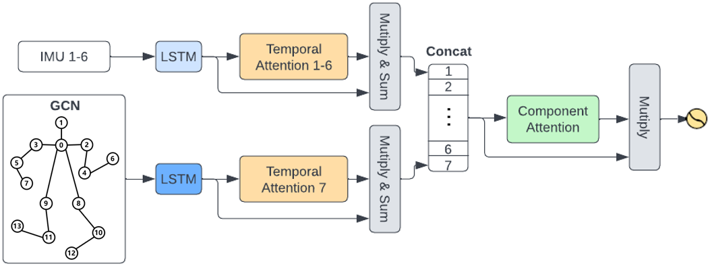 Component attention network for multimodal dance improvisation recognitionFu, J., Tan, J., Yin, W., Pashami, S., and Björkman, M.In ACM International Conference on Multimodal Interaction, Paris, France, Oct 2023 (10% Oral Session)
Dance improvisation is an active research topic in the arts. Motion analysis of improvised dance can be challenging due to its unique dynamics. Data-driven dance motion analysis, including recognition and generation, is often limited to skeletal data. However, data of other modalities, such as audio, can be recorded and benefit downstream tasks. This paper explores the application and performance of multimodal fusion methods for human motion recognition in the context of dance improvisation. We propose an attention-based model, component attention network (CANet), for multimodal fusion on three levels: 1) feature fusion with CANet, 2) model fusion with CANet and graph convolutional network (GCN), and 3) late fusion with a voting strategy. We conduct thorough experiments to analyze the impact of each modality in different fusion methods and distinguish critical temporal or component features. We show that our proposed model outperforms the two baseline methods, demonstrating its potential for analyzing improvisation in dance.